
Most small and mid-size business owners think about advertising in the same familiar places: Google Ads, Facebook Ads, Instagram, LinkedIn, local SEO, email marketing, and maybe a billboard if someone is feeling brave.
But there is another advertising channel most business owners never think about: in-flight video ads.
Yes, advertising to people while they are sitting on a plane.
At first, that may sound like a big-brand-only idea. And to be fair, in many cases it is not the cheapest advertising channel. This is not where a plumber with a $500 budget should start. But for certain businesses, especially those connected to travel, tourism, transportation, hospitality, events, or destination-based services, in-flight video advertising is worth understanding.
The reason is simple: marketing is not only about who sees your ad. It is also about where they are, what they are doing, and what they are thinking about when they see it.
A traveler sitting on a plane is in a very different mindset than someone scrolling social media at home.
That is what makes in-flight advertising interesting.
What Are In-Flight Video Ads?
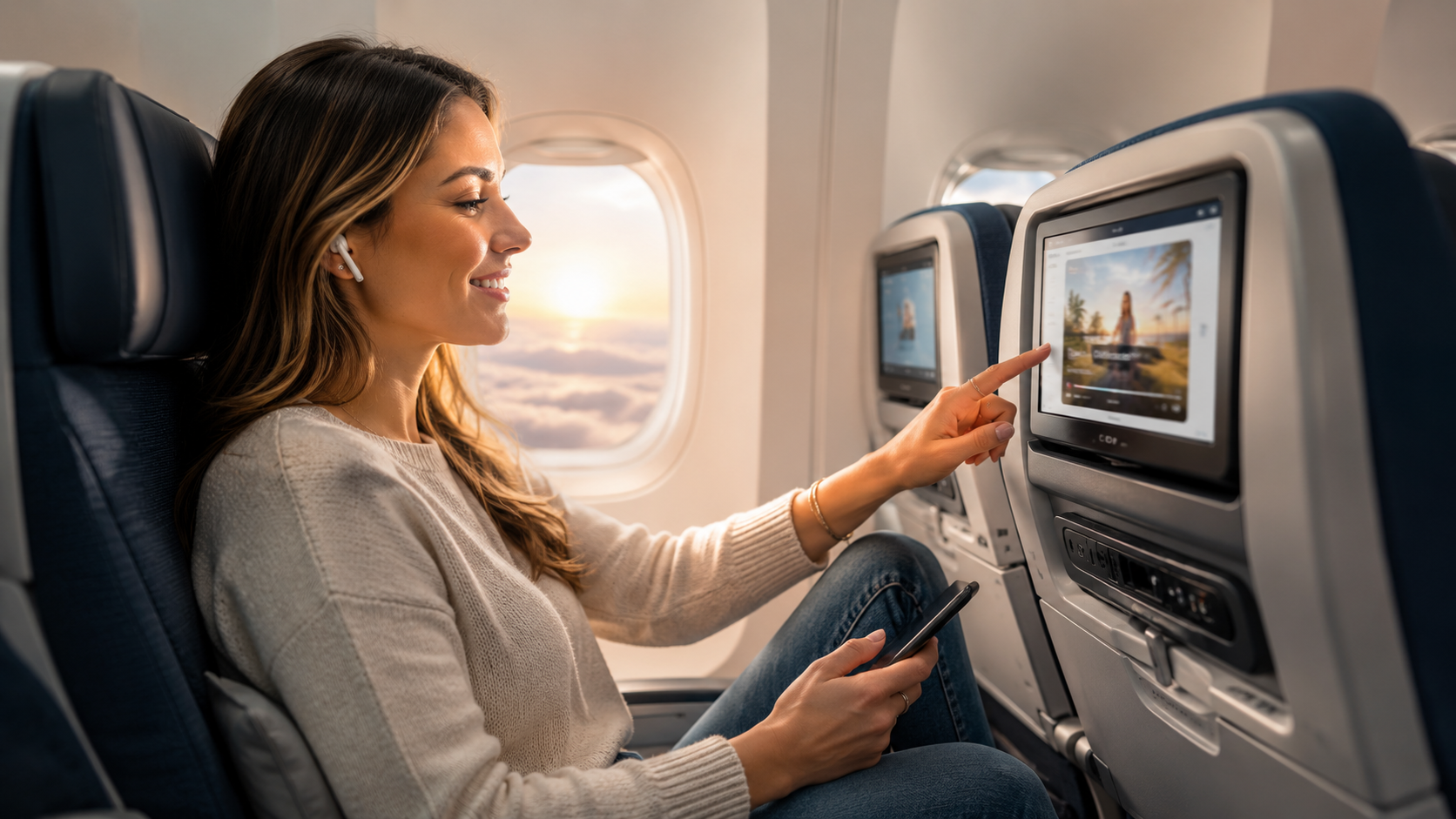
In-flight video ads are video advertisements shown to airline passengers during their travel experience.
These ads can appear through several formats, including:
- Sponsored Wi-Fi video ads
- Rewarded video ads in exchange for free internet access
- Pre-roll video before in-flight entertainment
- Video ads inside an airline Wi-Fi portal
- In-flight entertainment screen ads
- Airline app or passenger portal video placements
One of the companies in this space is Viasat Ads. Viasat offers in-flight advertising through airline Wi-Fi and passenger entertainment environments.
Their ad products can include sponsored internet, display ads, video ads, in-flight entertainment pre-roll, and route-based or destination-based campaigns.
A simple example would be this: A passenger gets on a flight to Denver. Before accessing Wi-Fi, they watch a short video ad from a mountain shuttle company that says: “Flying into Colorado? Book your ride to Vail before you land.”
That is very different from a random video ad shown to someone on YouTube.
The ad matches the moment.
And that is the larger marketing lesson. The best advertising channels are not always the loudest or newest.
They are the ones who connect the right message to the right person at the right time. That is the foundation of a strong digital marketing strategy.
How Do In-Flight Video Ads Work?
In-flight video ads are usually sold through an airline, an airline-owned media network, an in-flight connectivity provider, or a media company that works with airline inventory.
Viasat Ads is one example. United Airlines has also launched Kinective Media, its own airline media network, which uses travel behavior data to help brands reach travelers through United’s app, in-flight entertainment screens, and other airline media touchpoints.
The big difference between in-flight advertising and regular digital advertising is context.
Instead of only targeting someone based on interests or demographics, advertisers can often target based on travel-related signals, such as:
- Flight destination
- Route
- Travel timing
- Passenger environment
- Type of trip
- Travel behavior
- Device usage
- Airline media touchpoint
That matters because someone flying into Denver for ski season may need very different things than someone flying home from a business conference.
For marketers, this creates a rare opportunity: reach people during a specific life moment instead of just chasing them around the internet.
This is where a broader digital marketing strategy matters. The ad itself is only one part of the campaign. The offer, landing page, tracking, retargeting, and follow-up all have to work together.
Why In-Flight Ads Can Perform Differently
Most ads fight for attention in noisy environments.
On social media, people are scrolling fast. On Google, they are comparing options. On YouTube, they are waiting for the skip button. On websites, they may not even notice the banner ad.
On a plane, the environment is different.
Passengers are seated for an extended period of time. They have limited distractions. They are often bored, planning, anxious, excited, or mentally preparing for what happens when they land.
That gives video ads a different opportunity. Viasat’s “Altitude Advantage” research found that in-flight ads were more emotionally engaging than the same ads watched on the ground.
Their study also reported higher recall and stronger engagement in the first 10 seconds of the ad. From a marketing consultant’s point of view, the most useful takeaway is not “airplane ads are magic.” The takeaway is this:
Advertising works better when the message matches the moment.
A generic ad can still flop on a plane. Bad creative does not suddenly become good because it got a boarding pass.
But a relevant ad shown to the right traveler, on the right route, at the right time, has a better chance of being remembered.
That is the real marketing lesson.
It is also why many campaigns fail when the channel, message, offer, and audience are out of alignment. A business can spend money on ads all day, but if the strategy behind them is weak, the results usually follow. This is one of the most common reasons marketing fails when channels are out of alignment.
How Much Do In-Flight Video Ads Cost?
This is where small businesses need the straight answer.
In-flight video ads are usually not priced like boosting a Facebook post. Most campaigns are quote-based because pricing depends on the airline, routes, targeting, campaign length, ad format, impressions, and creative requirements.
For a true in-flight video campaign, especially something similar to Viasat sponsored Wi-Fi or in-flight entertainment video, a realistic starting test may land somewhere in the $10,000 to $25,000+ range.
Premium airline-owned media networks or larger in-flight entertainment placements can move much higher.
That means this is not usually a starter channel for most small businesses.
Before a business spends money on in-flight video ads, it should already have the basics in place:
- A strong website
- A clear offer
- Conversion tracking
- A dedicated landing page
- Google Analytics or CRM tracking
- A follow-up process
- A realistic understanding of customer value
Otherwise, the business may generate attention but lose the lead after the click. That is like paying for first-class visibility and sending people to a broken baggage claim.
Before investing in a channel like this, a business should already have its core paid ads strategy and conversion tracking in place.
That does not mean in-flight video ads are bad. It means they need to be evaluated like any other paid media channel: audience, cost, offer, customer value, and measurable business outcome.
Who Are In-Flight Video Ads Best For?
In-flight video advertising is best for businesses where travel context matters.
- Airport transportation companies
- Private car services
- Mountain shuttles
- Hotels and resorts
- Tourism brands
- Restaurants near airports or destination areas
- Local attractions
- Event venues
- Conference-related services
- Ski resorts
- Theme parks
- Destination medical or wellness services
- Premium regional brands
- Travel apps
- Experience-based businesses
For example, a luxury transportation company serving Denver International Airport could use in-flight video ads to reach passengers before they land.
A ski shuttle company could advertise to travelers flying into Colorado during winter.
A restaurant group near a major airport could promote reservations to incoming business travelers.
A tourism company could advertise activities to passengers flying into a specific destination.
That is where the channel makes sense.
It is not just about showing an ad on a plane. It is about reaching someone before they arrive, while they are already thinking about the trip.
This type of destination-based marketing works best when the business can connect its offer to the passenger’s next step.
Who Should Not Use In-Flight Video Ads?
Most local service businesses should not start here.
A plumber, roofer, HVAC company, or local contractor probably does not need in-flight video ads unless they are part of a larger regional brand strategy.
For those businesses, the money is usually better spent on:
- Local SEO
- Google Business Profile optimization
- Google Search Ads
- Retargeting
- Review generation
- Website conversion improvements
- Email follow-up
- Referral campaigns
In-flight video ads are more of an awareness and context-based channel. They can support demand, but they are not usually the fastest path to cheap local leads.
Marketing channels are tools. A hammer is useful, but not if you are trying to cut a sandwich.
This is also where business owners need to avoid one of the biggest paid advertising mistakes: chasing the newest platform before fixing the basics. If your website does not convert, your tracking is weak, or your offer is unclear, a bigger ad channel will only make those problems more expensive.
How Can Small and Mid-Size Businesses Use In-Flight Video Ads?
The best way for a smaller business to use in-flight video ads is with a very specific message tied to the traveler’s destination or intent.
Few examples.
Airport Transportation
“Landing in Denver? Your private ride to Vail can be waiting.”
This works because the traveler may need transportation soon. The ad is timely and useful.
Tourism or Local Experiences
“Flying into Boulder this weekend? Add a local concert experience to your trip.”
This works because travelers often make plans while traveling or shortly after arriving.
Restaurants
“Arriving tonight? Book dinner before you land.”
This could work for restaurants near hotels, airports, resorts, or convention centers.
Resorts and Hotels
“Your mountain weekend starts before you land.”
This helps build anticipation and keeps the brand connected to the travel experience.
Events and Conferences
“Coming to town for the conference? Book executive transportation now.”
This works because the ad speaks directly to the reason for travel.
The creative should be simple, clear, and immediately relevant.
Bad version: “We provide premium transportation solutions with excellent customer service.”
Better version: “Landing in Denver? Book your ride to the mountains before you touch down.”
The second version wins because it connects to the passenger’s real situation.
This is the same principle that applies across most marketing channels for small businesses. The clearer the message, the easier it is for the customer to understand why it matters.
What Should the Landing Page Include?
If a business runs in-flight video ads, it should not send people to a generic homepage.
The landing page should match the ad.
For example, if the ad says “Book your ride from Denver to Vail,” the landing page should be specifically about Denver-to-Vail transportation.
- A clear headline
- A simple booking form
- Strong visuals
- Trust signals
- Reviews
- Pricing or starting rates if possible
- A phone number
- A clear call to action
- Mobile-friendly design
- Fast load speed
The goal is to make the next step obvious.
Passengers are not going to study your entire website while sitting on a plane. They need a clean path from interest to action.
This is why the landing page matters as much as the ad. A strong website design and landing page strategy can be the difference between a campaign that generates leads and one that only generates traffic.
A good ad gets attention. A good landing page turns that attention into action.
How Should In-Flight Video Ads Be Tracked?
Tracking matters because in-flight video ads are not cheap.
At minimum, businesses should use:
- A dedicated landing page
- UTM tracking
- A unique promo code
- A call tracking number
- CRM source tagging
- Form submission tracking
- Retargeting audiences
- Post-campaign lead review
The goal is not always direct last-click attribution.
In-flight ads may influence someone who later searches the brand, visits the website, clicks a Google Ad, or books after landing. That means the campaign may assist other channels rather than take all the credit itself.
That is important for business owners to understand.
If they judge the campaign only by immediate clicks, they may miss the bigger picture. But if they do not track anything, they are just guessing with a nicer dashboard.
For smaller businesses, marketing performance tracking becomes non-negotiable. The more expensive the channel, the more important it is to know what happened after someone saw the ad.
That does not mean tracking will be perfect. It rarely is. But it should be clear enough to understand whether the campaign helped move people through the customer journey.
How In-Flight Ads Fit Into the Customer Journey
In-flight video advertising should not be treated as a standalone magic trick.
It should fit into the broader customer journey.
A traveler may see the ad on the plane, visit the landing page, leave without booking, search the brand later, click a retargeting ad, read reviews, and then finally submit a form after they land.
That is why the campaign needs more than just the video ad.
A stronger setup may include:
- In-flight video ad
- Dedicated landing page
- Retargeting ads
- Google Search campaign
- Email follow-up
- CRM tracking
- Call tracking
- Review and reputation strategy
This is where small and mid-size businesses need to think beyond one channel. The channel creates the first touchpoint, but the full system creates the result.
At PSP Compass Solutions, we look at marketing through that full picture: audience, message, website, tracking, and follow-up. That is what separates a real campaign from just buying ad space and hoping for the best.
Final Takeaway
In-flight video ads are not for every small business.
They are not cheap. They are not a replacement for SEO, Google Ads, local search, or a strong website. And they are not a magic lead machine.
But for travel-based, destination-based, or hospitality-related businesses, they can be a powerful way to reach people during a high-attention moment.
The real value is not simply that passengers are on a plane.
The value is that passengers are in motion. They are going somewhere. They are thinking about what comes next. If your business solves a problem connected to that next step, in-flight video ads may be worth exploring.
For most small and mid-size businesses, the right question is “Would someone flying into our market care about our offer before they land?”
If the answer is yes, in-flight video advertising could be a smart channel to research.
If the answer is no, keep your budget grounded.
Need Help Choosing the Right Marketing Channel?
Before testing a high-cost channel like in-flight video advertising, it is worth stepping back and asking whether your full marketing system is ready.
At PSP Compass Solutions, we help small and mid-size businesses build practical marketing strategies around the right audience, the right offer, and the right tracking, not just the newest shiny ad platform.
If you are trying to figure out which marketing channels actually make sense for your business, contact PSP Compass Solutions and let’s talk through your next campaign.
Share this Blog Post on Social Media



LinkedIn for Business Owners in 2026: A Practical Guide to Growing Through Content and Conversations