Over time, I’ve noticed something consistent across different businesses.
When marketing isn’t working, it’s rarely because nothing is being done.
It’s usually because the effort is out of alignment.
Most companies tend to lean heavily in one direction. They either focus on short-term results or long-term brand. And the challenge is, those two things are meant to work together, not separately.
The Two Types of Marketing Most Businesses Gravitate Toward
In almost every marketing conversation, the same divide shows up.
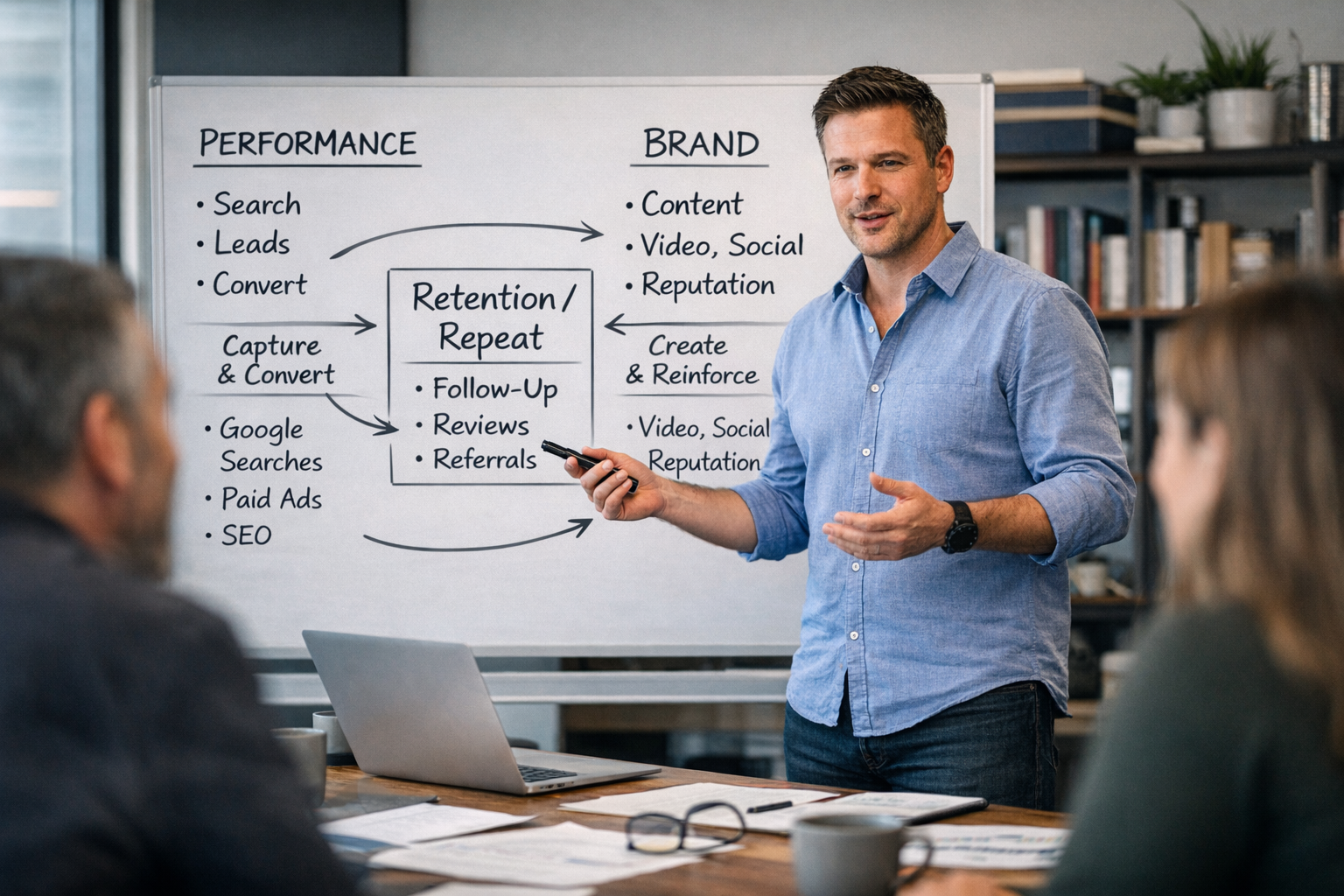
Some businesses prioritize what can be tracked, paid ads, SEO, lead generation, and anything tied directly to measurable ROI. If it can’t be measured, it’s difficult to justify.
Others focus more on brand—content, awareness, and long-term positioning. The thinking there is simple: if people don’t know or trust the business, nothing else matters.
Both perspectives are valid. But on their own, each one creates limitations.
What Marketing Experts Have Been Saying for Years
This balance isn’t a new idea.
Mark Ritson has consistently emphasized the importance of combining short-term and long-term marketing. Performance marketing drives immediate results, while brand marketing builds future demand.
At the same time, Rory Sutherland has highlighted something equally important:
Not everything that matters can be measured.
That’s where many businesses get stuck, because in practice, decisions tend to follow what’s easiest to track.
The Tendency to Prioritize What’s Measurable
In many cases, marketing decisions are driven by metrics like cost per click, cost per lead, and return on ad spend.
These are important. But over time, this can create a blind spot.
Investment shifts toward what can be directly tracked and away from what contributes more gradually, such as brand, reputation, and long-term positioning.
👉 If you want to go deeper into this, here’s a breakdown of how we approach
performance-driven campaigns and measurable ROI:
https://www.pspcompass.com/PaidAdsPPCManagement
What This Looks Like in Practice
Across different industries, the pattern tends to look similar.
There’s usually a solid effort to generate demand. Campaigns are running, traffic is coming in, and leads are being generated.
But when you look closer, the breakdown often happens after that first interaction.
Follow-up isn’t consistent. The next step isn’t always clear. The customer experience varies. And there isn’t always a system in place to turn one customer into repeat business.
From the outside, it can look like a marketing issue.
In reality, it’s often a
conversion and retention issue.
The Other Side of the Equation
On the other end, some businesses invest heavily in visibility.
They create content consistently. They build awareness. They show up across multiple channels.
Over time, this builds recognition and familiarity.
But when someone actually engages, the path forward isn’t always clear.
There may not be a defined offer. The next step isn’t obvious. And there isn’t always a structured way to move from interest to action.
So while attention is there, it doesn’t always translate into growth.
👉 If you’re building brand awareness, it has to connect back to a system that converts: https://www.pspcompass.com/local-search-engine-optimization
Why This Pattern Keeps Showing Up
From what I’ve seen, this usually comes down to how businesses manage risk.
Performance feels more controllable. Brand feels more uncertain.
So most companies naturally lean toward what they can measure.
But marketing doesn’t work in isolation.
The Real Opportunity
The challenge isn’t choosing between brand and performance.
It’s understanding how they work together—and in what order.
Brand creates demand.
Performance captures it.
When one is missing, the other becomes less effective.
What This Looks Like at Different Stages
What this looks like in practice varies with the size of the business, but the pattern remains the same.
A smaller business might focus on capturing demand through search while building trust through reviews and simple content. Over time, that combination makes each lead easier to convert because there’s already some familiarity before the first interaction.
As businesses grow, they start layering in more structure, retargeting, email follow-up, and consistent content that builds authority. Leads don’t feel as cold, and the sales process becomes more efficient because trust is already in place.
At a larger scale, companies invest heavily in brand to create demand at the top, while maintaining highly optimized systems to capture it at the bottom. By the time someone is ready to buy, the decision feels easier because the brand is already established.
Different levels, same principle.
Where This Leads
When marketing underperforms, the natural reaction is to do more.
More ads. More content. More channels.
But in many cases, the bigger opportunity isn’t adding more—it’s improving what’s already there.
Before scaling anything, it’s worth stepping back and asking:
- Is demand being converted consistently?
- Is the experience clear and repeatable?
- Is there a system in place to support repeat business?
Final Thought
Marketing works a lot better when the system behind it does too.
Not sure what applies to your business?
Book a free strategy call and we'll tell you honestly what we'd prioritize.
Share this Blog Post on Social Media



LinkedIn for Business Owners in 2026: A Practical Guide to Growing Through Content and Conversations