
Most businesses think they need more marketing, more ads, more traffic, more content.
But the real issue isn’t getting attention.
It’s
turning that attention into revenue.
Many businesses are actively marketing, yet still struggle to generate consistent leads and sales. The problem usually isn’t effort, it’s that their marketing isn’t connected to a system that converts.
Below are the five most common marketing mistakes small businesses make, and how to fix them.
The Question Most Businesses Can’t Answer
If you were asked today:
👉 Which marketing channel actually drives your revenue?
Would you be able to answer confidently?
Most businesses cannot.
They’re tracking data, but not the right data.
The Data Illusion
Businesses today track:
- Website traffic
- Clicks
- Impressions
But none of these metrics clearly answer what’s actually generating revenue.
👉 If your data doesn’t tell you what’s making you money, it’s not useful—it’s just decoration.
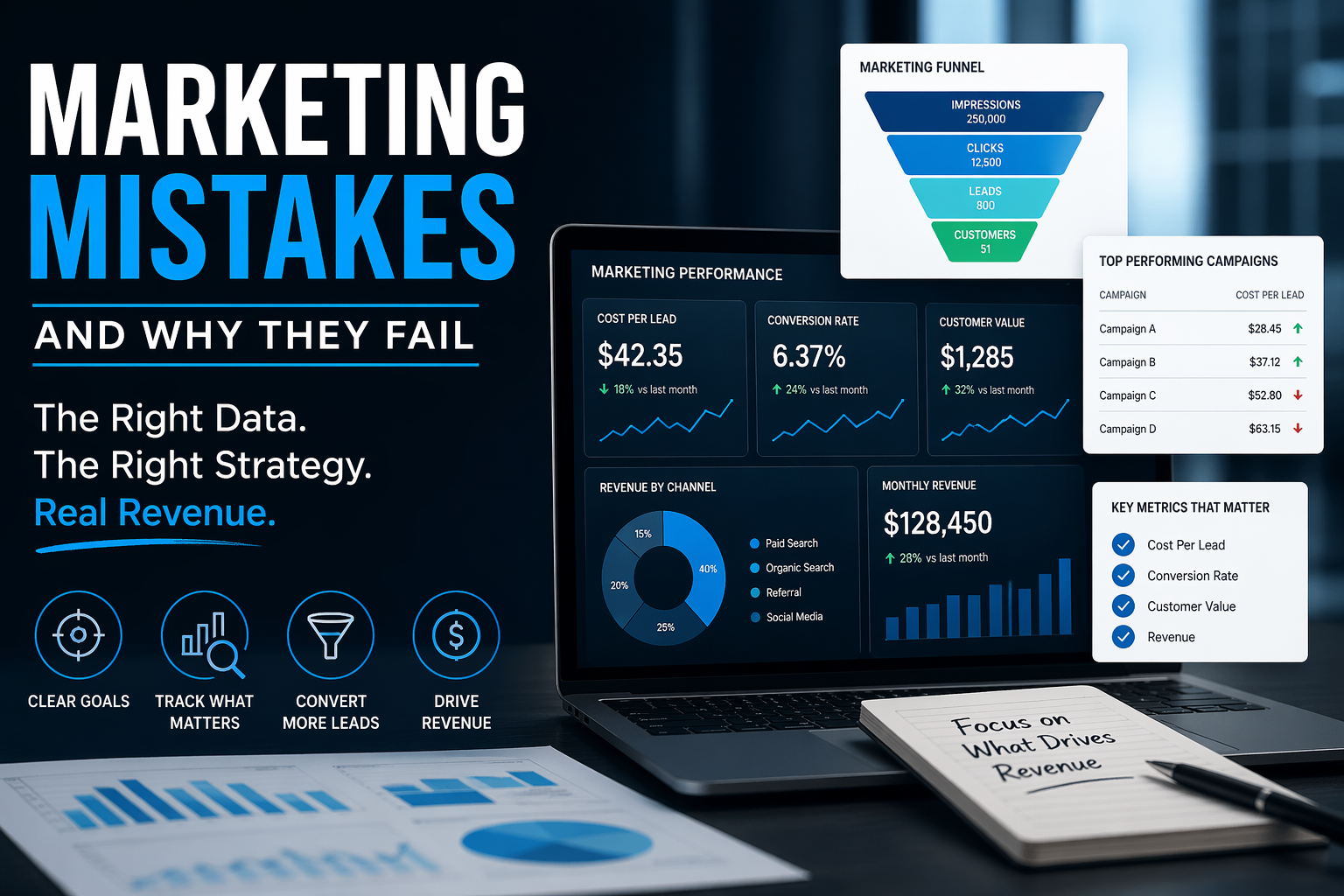
To make informed decisions, businesses need to focus on the right metrics:
- Cost per lead (CPL)
- Conversion rate (CVR)
- Customer value (LTV)
The Real Problem
Marketing creates opportunity.
Revenue is created by systems.
If your business is generating attention but not results, something is breaking between the initial interaction and the final sale.
1. No Clear Goal
Many businesses aim for:
- More traffic
- More exposure
- More engagement
However, these are not clear business goals.
A measurable goal looks like:
- Increasing qualified leads
- Generating more calls
- Driving more sales
👉 Without a defined outcome, marketing efforts lack direction.
2. Confusing Activity with Results
Posting content, running ads, and sending emails are all important—but they are still just activity.
👉 Activity does not guarantee results.
Marketing should always connect to:
- Cost per lead
- Conversion rate
- Revenue
If it’s not tied to measurable outcomes, it’s not driving growth.
3. No Follow-Up System (Where Most Revenue Is Lost)
This is one of the most common and costly mistakes.
Most leads do not convert immediately:
- In B2C markets, roughly 10–15% are ready to buy right away
- In B2B markets, often only ~5% are actively buying
This means the majority of potential customers require ongoing engagement.
Without a structured follow-up system:
- Opportunities are missed
- Marketing dollars are wasted
- Competitors gain the business instead
👉 A simple system including email, CRM tracking, and retargeting can significantly improve results.
4. Trying to Do Everything
Businesses often attempt to manage:
- SEO
- Social media
- Paid advertising
- Email marketing
- AI tools
Spreading efforts across too many channels leads to inconsistency and weak performance.
👉 The most effective approach is to focus on one or two channels and execute them well.
5. Not Understanding the Customer
Marketing frequently focuses too much on the business rather than the customer.
Customers are primarily concerned with:
- Their problem
- The solution
- The expected outcome
If messaging does not clearly address these points, engagement and conversions will suffer.
The Metrics That Actually Matter
To properly evaluate marketing performance, businesses should track five key metrics:
- Traffic Sources – Where attention is coming from
- Lead Sources – What converts attention into interest
- Cost Per Lead – The cost of generating interest
- Conversion Rate – The percentage of leads becoming customers
- Customer Value – The revenue generated per customer
These metrics are interconnected and provide a complete picture of performance.
Where to Find These Metrics
Most businesses already have access to this data:
- Google Analytics → traffic sources
- Website forms, call tracking, CRM → lead sources
- Advertising platforms → cost per lead
- CRM or analytics → conversion rates
- Sales data → customer value
👉 The challenge is not access to tools—it’s ensuring they are properly set up and connected.
A Simple Framework for Growth
Rather than adding more complexity, focus on a clear system:
- Define a clear goal
- Focus on the right marketing channels
- Execute consistently
- Implement a follow-up system
- Track revenue-focused metrics
The Bottom Line
If you are tracking data but still unsure what is working, the issue is not a lack of information; it is a lack of clarity.
👉 Focus on what drives revenue.
Because:
- Traffic does not grow a business
- Leads do not grow a business
Customers do.
If your marketing feels active but not effective, it may not be a marketing issue—it may be a systems issue.
At PSP Compass Solutions, we help businesses connect their marketing, sales, and data so they can clearly understand what’s driving revenue and where to improve.
👉 If you want clarity on your marketing and a system that actually works, schedule a consultation or reach out to learn more.
Not sure what applies to your business?
Book a free strategy call and we'll tell you honestly what we'd prioritize.
Share this Blog Post on Social Media




LinkedIn for Business Owners in 2026: A Practical Guide to Growing Through Content and Conversations