
The world of marketing is changing fast!
Artificial intelligence isn’t just changing how we create content; it’s redefining how customers discover brands.
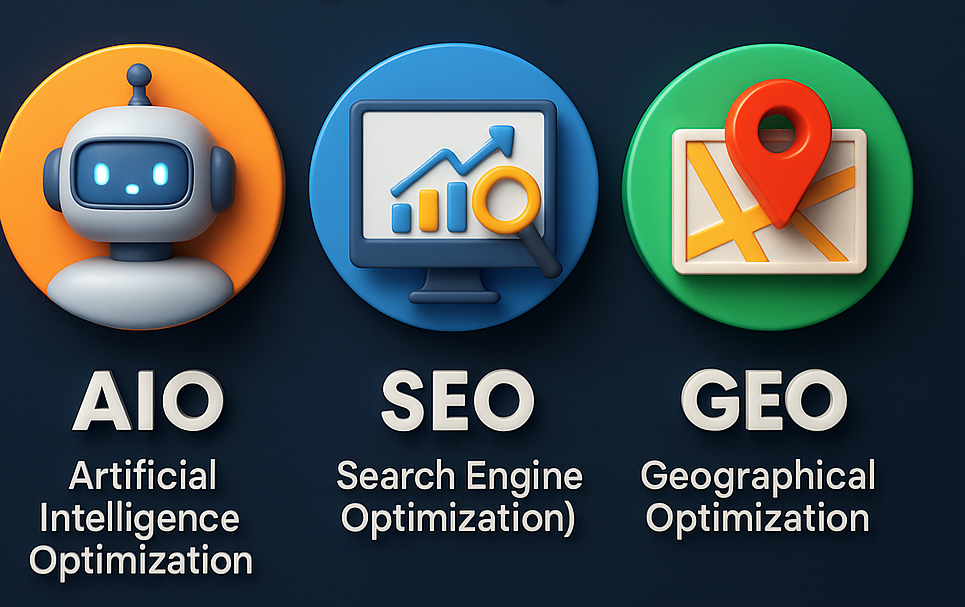
We’re now entering a new era defined by AIO (Artificial Intelligence Optimization), alongside the familiar SEO (Search Engine Optimization) and GEO (Geographical Optimization).
If your business wants to be found — whether by Google, ChatGPT, or the next wave of AI-driven search — it’s time to understand how these three pillars of modern marketing work together.
What Is AIO? (Artificial Intelligence Optimization)
AIO, or Artificial Intelligence Optimization, is about helping AI systems — not just search engines — find, understand, and trust your business.
Instead of optimizing for Google’s crawler alone, AIO focuses on training AI models to “see” your brand across the web. This means building authority and consistency wherever AI tools gather their data — across Reddit, Quora, YouTube, LinkedIn, and your own content.
When people search for help with marketing in this AI-driven world, they’re using terms like:
- AI-driven marketing
- digital marketing with AI
- AI SEO services
If your content doesn’t clearly connect your business with these modern search phrases, AI won’t surface you as a relevant brand.
AIO means writing content that’s semantically rich, factually grounded, and entity-based — ensuring your business name, industry, and expertise are recognized as part of a larger web of authority online.
SEO: Still the Foundation — But Now Smarter
Traditional SEO isn’t gone; it’s evolved. Think of SEO as the foundation that supports your AIO strategy. Search engines still drive huge portions of web traffic, and the better structured your site is, the more AI models can interpret your content.
Smart SEO today means:
- Structuring pages with clear schema markup so both Google and AI can interpret them.
- Building topic clusters around core services — for example, one cluster might target “AI marketing strategy,” another “AI content strategy.”
- Prioritizing E-E-A-T (Experience, Expertise, Authoritativeness, Trustworthiness) so algorithms trust your information.
Businesses offering AI SEO services are already using these techniques — optimizing for both search results and AI recommendations simultaneously.
GEO: The Power of Location in a Global AI Landscape
GEO, or Geographical Optimization, ensures your business shows up where your customers actually are — both online and offline. In a world where voice search and AI assistants personalize results based on proximity, local presence is everything.
Here’s what to focus on:
- Keep your Google Business Profile current.
- Maintain consistent NAP (Name, Address, Phone) info everywhere.
- Generate authentic reviews on Google and Reddit.
- Create localized content using phrases like “AI-driven marketing in [City]” or “AI automation for business near me.”
GEO optimization makes you discoverable not just in Google Maps, but also in AI-driven queries like, “What’s the best AI marketing help near me?”
How AIO, SEO, and GEO Work Together
These three forces now shape modern organic marketing:
- AIO ensures AI models understand your brand.
- SEO ensures search engines rank your content.
- GEO ensures customers find you locally.
Together, they create a full visibility loop — helping your business appear in search results, AI-generated answers, and location-based recommendations.
For example, if you run a digital marketing firm, your optimized presence might connect to key searches like:
- “digital marketing with AI”
- “AI content strategy for startups”
- “AI automation for business growth”
Each phrase connects intent (“help me grow with AI”) to your service offering — the foundation of true AIO success.
What Businesses Should Do Now
If you want your business to stay visible and competitive in the age of AI, here’s what to focus on immediately:
1. Rethink Keyword Research for AI Discovery
The days of chasing keywords with the highest search volume are over.
Now, you need to consider
AI intent — what people ask AI systems, not just Google.
When researching, include natural language and question-based keywords, such as:
- “Which AI marketing strategy is best for small business?”
- “How can I use AI SEO services to grow online?”
- “What’s the best AI content strategy for e-commerce?”
Tools like SpyFu can reveal emerging trends — for example, these Top 5 Keywords Right Now (AI + Marketing Strategy Focus):
- AI-driven marketing
- digital marketing with AI
- AI SEO services
- AI content strategy
- AI automation for business
Use these as core clusters when building your content calendar, web pages, and social posts.
2. Create Entity-Rich, Multichannel Content
AI systems thrive on context and authority. That means your business should:
- Publish expert-level blogs (like this one) targeting your core keywords.
- Build a
Reddit profile and join discussions relevant to your industry.
AI models learn from real Reddit conversations, so being part of that ecosystem builds visibility. - Share insights on LinkedIn, YouTube, and industry blogs to strengthen your digital footprint.
3. Optimize Your Website for Humans and Machines
Write for humans first, but structure for AI:
- Use headings, bullet points, and FAQs.
- Add schema markup for services, locations, and people.
- Use your target keywords naturally: “AI SEO services,” “AI content strategy,” etc.
4. Encourage Reviews and Mentions
AI increasingly relies on sentiment data — not just links. Encourage happy clients to:
- Leave reviews on Google and Reddit threads.
- Mention your business name alongside keywords like “AI automation for business” or “digital marketing with AI.”
These mentions act as digital signals for AI’s understanding of your brand authority.
The Future of Organic Marketing
The rise of AI doesn’t make SEO obsolete — it makes it more intelligent.
Businesses that adapt to AIO, leverage SEO best practices, and invest in GEO optimization will win in both search rankings and AI recommendations.
If your brand is clear, credible, and consistently referenced — in structured content, local profiles, and social discussions — you’ll not only rank higher on Google but also show up in AI-generated answers.
Final Thought
The brands that dominate the next decade will be those that understand this truth:
It’s not just about being searchable anymore.
It’s about being findable by both people and machines.
Start today by aligning your AIO, SEO, and GEO efforts — and make sure your business owns the conversation around AI-driven marketing, digital marketing with AI, AI SEO services, AI content strategy, and AI automation for business.
Your future customers — and the AI systems guiding them — are already looking.
Not sure where this fits in your plan? See how we approach AI training.
Not sure what applies to your business?
Book a free strategy call and we'll tell you honestly what we'd prioritize.
Share this Blog Post on Social Media





LinkedIn for Business Owners in 2026: A Practical Guide to Growing Through Content and Conversations